


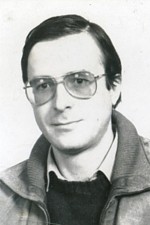
Ioan Petru Culianu (1950–1991)
Ioan Petru Culianu (1950–1991) was a Romanian historian of religions, novelist, and public intellectual, and one of the most distinguished figures in the study of religion in the second half of the twentieth century. He stands as the intellectual patron of the Institute for Religious Studies that bears his name. Trained initially at the University of Bucharest, where he studied Romanian language and literature before pursuing Italian, Culianu left Romania in 1972 after requesting political asylum during a summer school organized by the University of Perugia. He subsequently settled in Italy, continuing his academic training at the Università Cattolica del Sacro Cuore (1973–1976), where he specialized in the history of religions. Between 1976 and 1987, he was affiliated with the University of Groningen, first as a teaching assistant in Romanian language and later as an associate professor in the Department of Romance Languages. In January 1987, he received his doctorate from the University of Paris IV (Sorbonne) under the supervision of Michel Meslin, with a dissertation entitled Recherches sur les dualismes d’Occident. Analyse de leurs principaux mythes. In 1986, at the invitation of Mircea Eliade, Culianu served as a visiting professor at the University of Chicago. Following Eliade’s death, he succeeded him in 1988 in the Chair of the History of Religions, establishing himself as a major voice in the field within Western academia.
Culianu’s scholarly output is notable for both its scope and originality. The author of more than fifteen academic volumes, as well as novels, scholarly articles, and journalistic essays, his work focused on Gnosticism, the religious imagination, and conceptions of the soul’s journey in the afterlife, as well as on the contribution of Mircea Eliade to the development of the history of religions as a modern academic discipline. After settling in the West, Culianu adopted a firmly anti-totalitarian and anti-communist stance, becoming a vocal critic of the regime of Nicolae Ceaușescu and a supporter of intellectual dissent, including the Iași group led by Dan Petrescu. At the same time, he distinguished himself as a lucid and balanced public intellectual, criticizing both the appeal of the far right within segments of the Romanian diaspora and the forms of neo-communism that emerged in post-1989 Romania. Ioan Petru Culianu was assassinated under still unresolved circumstances on May 21, 1991, inside the University of Chicago. His death remains one of the most controversial episodes in recent intellectual history. Through his substantial body of work, which reshaped the study of religion at its core, and his intellectual and civic engagement, Culianu remains a central figure in the critical study of religion and a foundational reference point for the mission and orientation of the Institute.